Sep 26, 2026◆6 min read
AI sovereignty: when assistance becomes dependence
The point of control isn't simply running a model locally. It's whether I can still check, refuse, change or replace the system I rely on.
I use other people's AI every day. That alone doesn't make me dependent. Dependence begins when the system becomes necessary to do my work and I can no longer meaningfully check its answers, refuse its recommendations or replace it without losing what I've built around it.
I don't think there is one universal percentage of AI use after which I lose autonomy. The cutoff is practical: if a provider vanished tomorrow, could I keep working within a tolerable time? If an answer sounded wrong, could I examine the evidence or reach a different source? If the product changed its rules, could I take my work somewhere else? Research on AI sovereignty calls the realistic alternative to total independence managed interdependence: reducing risk through choices about who supplies the parts of the stack.1
Dependence has more than one shape
Operational dependence is the obvious one. I can't work if the service is down, prices change or an account is suspended. A backup model that exists only as a name on a list isn't a fallback; I need the data, tools and time to switch to it.
Swipe diagram to explore →
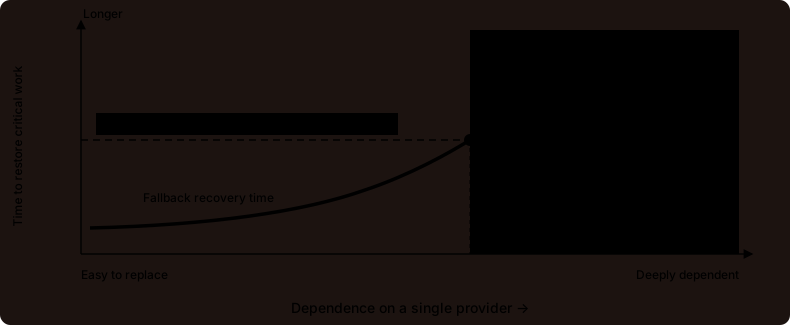
Information dependence is quieter. If an assistant becomes my only path to articles, documentation and people with contrary views, it can narrow what I even consider. Work on algorithmic information gatekeeping examines the consequences of letting systems mediate access to knowledge.2 I still ask assistants questions. Sometimes the answer should start an investigation instead of ending one.
Swipe diagram to explore →

Decision dependence is subtler still. I may retain the final "approve" button while losing the ability to judge the options I'm shown. A survey of knowledge workers found that higher confidence in generative AI was associated with less reported critical thinking in AI-assisted work; it did not establish that AI inevitably makes people worse thinkers.3 The uncomfortable test for me is whether I can explain why I accepted an answer after the tool is closed.
Swipe diagram to explore →

There is also adaptation dependence. My prompts, corrections, working memory and integrations accumulate inside a product, but I may have little say in how that product changes. Exporting a chat history is not the same as moving an operating system for my work.
Where the model runs matters, but it isn't the whole answer
Running a model on my own machine gives me more control over access, updates and where inference happens. Hosting it on a server I administer gives me some of the same choices, although a rented server still has an operator. Using a proprietary hosted model trades some of that control for a service that may be easier to use or more capable at a particular job.
These arrangements aren't clean opposites. A local app can quietly send requests to remote services. An open-weight model can run on rented hardware. Access to model weights makes independent testing and adaptation possible, but does not by itself make the training data or embedded biases auditable.1
I care about being able to keep using a version that works and, where the terms and weights permit it, change the model's behavior. Research on refusal behavior shows that some learned model behavior can be modified; that doesn't mean any model can be made accurate, unbiased or safe with one edit.4 I would still need evaluations, limits on actions and a way to notice when I'd made things worse.
The harness is where much of my control lives
The harness is everything around the model: which information it sees, which tools it can call, where memory sits, whose credentials it uses and who authorizes an action. A provider can host a powerful model without owning my mailbox tokens or deciding what gets sent from my machine. Conversely, a vendor-controlled agent with my accounts connected may make many useful decisions I can't easily inspect or change.
The distinction is concrete. I can keep credentials and action permissions in software I control, use a remote model for a selected question, and require a separate approval before sending an email. The content sent for remote inference still leaves my machine; holding the password locally doesn't make the inference private. If I need the whole process to stay local, I must check the model, embeddings, logs and any other networked components too.
Swipe diagram to explore →
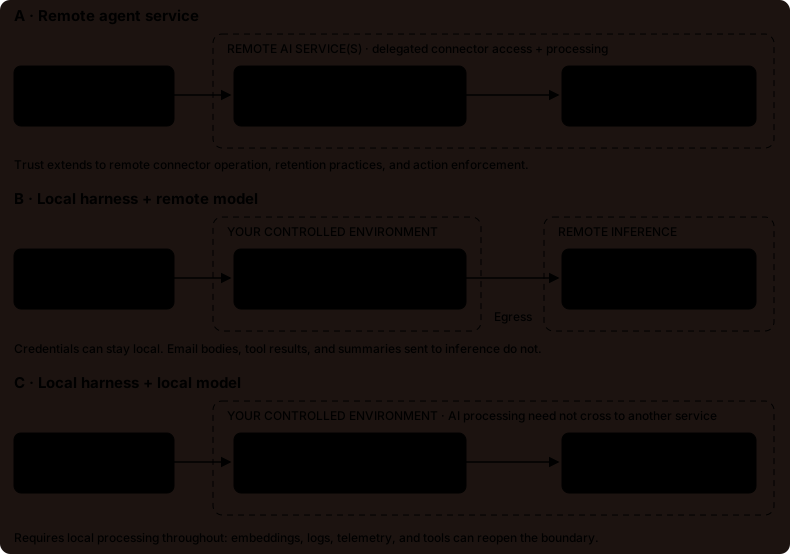
I want memory I can inspect and correct; defaults I can edit; narrow, revocable account permissions; and a record of what the assistant actually did. I want "read," "draft," "send" and "delete" to be different powers, enforced outside the model. Prompt-injection research shows why: malicious content returned from external tools can try to redirect an agent toward actions the user never requested.5
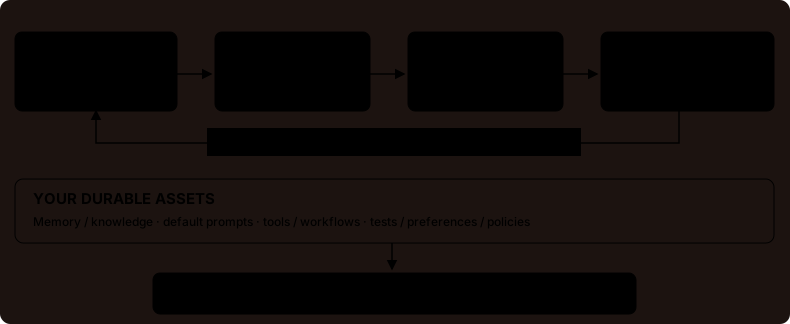
Owning the harness also lets me improve it. I can change a retrieval step, test a new approval rule or swap a model without surrendering every other part of the workflow. Studies of agent interfaces and memory-backed feedback support the idea that the surrounding system changes what an agent can accomplish; neither proves that any particular harness edit will help.67
Swipe diagram to explore →
Keep an exit that works
My test for sovereignty is deliberately ordinary. Can I take my notes, source material and workflows elsewhere? Can I still reach primary evidence? Can I run or replace the essential parts before an outage becomes a crisis? Can I tell an agent "no" and know that the action gate will hold?
At the end of that list is my usage data. If I own the records of my corrections and successful work, I may be able to curate them for future personalization or fine-tuning. A LoRA adapter is one possible technique, not the definition of sovereignty, and raw conversations are not automatically a good training set.8 I'd keep that option available without letting it distract me from the more urgent controls: continuity, independent judgment, memory, credentials and actions.
I don't need to own every transistor in the stack. I need enough control to keep working, challenge what I'm told and walk away when I have to.
Sources
- Is AI sovereignty possible? Balancing autonomy and interdependence (Tanner et al., Brookings, 2026)
- Negative consequences of information gatekeeping through algorithmic technologies (Potnis, Tahamtan and McDonald, JASIST, 2025)
- The Impact of Generative AI on Critical Thinking (Lee et al., CHI 2025)
- Refusal in Language Models Is Mediated by a Single Direction (Arditi et al., NeurIPS 2024)
- AgentDojo: A Dynamic Environment to Evaluate Prompt Injection Attacks and Defenses for LLM Agents (Debenedetti et al., NeurIPS 2024)
- SWE-agent: Agent-Computer Interfaces Enable Automated Software Engineering (Yang et al., 2024)
- Reflexion: Language Agents with Verbal Reinforcement Learning (Shinn et al., NeurIPS 2023)
- LoRA: Low-Rank Adaptation of Large Language Models (Hu et al., 2021)